Running a Christmas market stall for four weeks is very different from setting up for a weekend craft fair. Your stall needs to attract customers, display products effectively and provide a practical working space throughout the busy weeks leading up to Christmas.
A table arrangement that works perfectly for a two day event may become frustrating after several weeks of trading. Limited storage, crowded displays, poor access to stock and unsuitable furniture can all make daily operations more difficult than necessary.
Whether you’re selling handmade gifts, Christmas decorations, clothing, jewellery, candles or festive food, planning your stall furniture from the beginning can save time and help you make better use of the space available.
For traders who only need furniture during the festive season, hiring tables, chairs and accessories also avoids purchasing equipment that will need storing once the market closes.
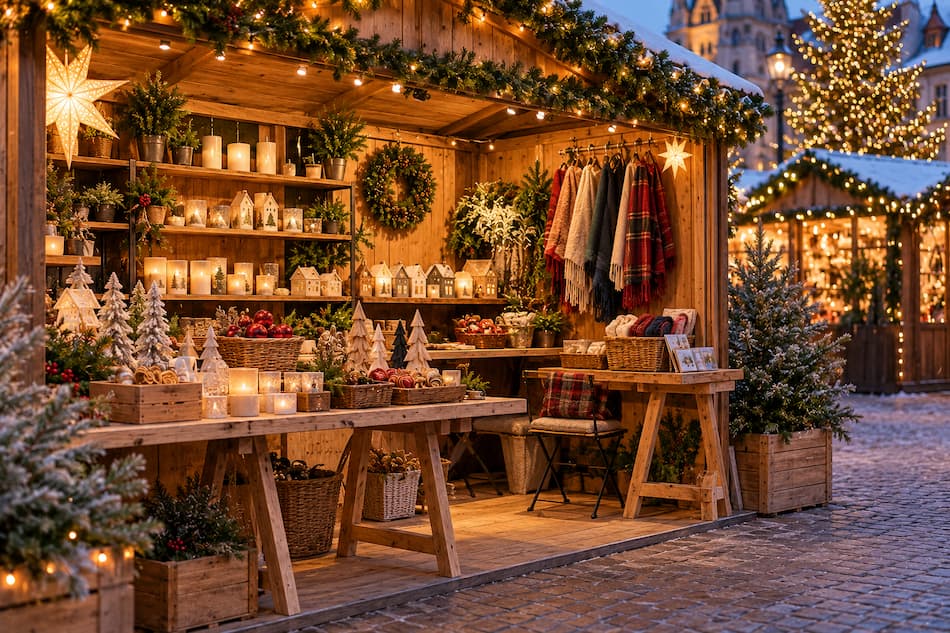
Planning For Four Weeks Of Trading
A Christmas market stall may operate for 20 to 30 trading days, depending on the organiser’s schedule. During that period, furniture is used repeatedly, products are replenished and displays may change as stock sells.
The first step is understanding the space and facilities provided by the market organiser.
Some markets supply fully constructed wooden chalets with counters, lighting and lockable storage. Others provide marquees, temporary structures or an allocated pitch where traders must bring their own equipment.
Before arranging furniture hire, establish:
- The dimensions of the stall and available floor space
- Whether a counter or display surface is already provided
- Access to electricity and lighting
- Available storage behind or beneath displays
- Whether furniture can remain in place overnight
- Restrictions on placing displays outside the stall
- Delivery and collection arrangements
- Any requirements for securing furniture after closing
These details determine the type and quantity of furniture needed. They also help avoid hiring items that cannot be accommodated within the allocated pitch.
Choosing Furniture For Your Christmas Market Stall
The most useful stall furniture provides enough display space without making it difficult for traders to work or customers to browse.
Traditional trestle tables, rustic wooden tables, folding chairs and high tables can all serve different purposes depending on the products being sold.
| Furniture | Typical Use | Practical Advantage |
|---|---|---|
| Trestle Tables | Product displays, payments and stock preparation | Versatile surfaces available in different sizes |
| Rustic Wooden Tables | Gift displays, handmade products and seasonal collections | Attractive natural finish without needing table linen |
| High Tables | Featured products, demonstrations and customer interaction | Provides an alternative display height |
| Folding Chairs | Trader seating during quieter periods | Can be folded away to free up working space |
| Clothes Rails | Clothing, accessories and hanging merchandise | Keeps garments organised and accessible |
BE Event Hire supplies Christmas market furniture hire for individual traders and organisers, with nationwide delivery and collection available.
Trestle Tables For Christmas Market Displays
Trestle tables are one of the most practical choices for temporary retail because they can accommodate different products and are straightforward to arrange within a stall.
A traditional 6ft trestle table provides a useful surface for gift displays, folded clothing, packaged food and Christmas decorations. Smaller tables may be better suited to compact pitches where every centimetre matters.
BE Event Hire offers trestle table hire in several sizes, allowing traders to select tables around the available space rather than trying to make one standard arrangement fit every stall.
For a four week market, think about more than the initial display.
Your table may also need to accommodate payment equipment, shopping bags, packaging, spare products and daily stock replenishment.
A display that fills every available surface on opening day may leave nowhere to work once trading begins.
Rustic Tables For Festive Displays
Rustic wooden furniture can work particularly well in traditional Christmas markets, especially those featuring wooden chalets, handmade gifts and seasonal produce.
The natural finish provides an attractive setting for candles, ceramics, wreaths, decorations, artisan food and other gift products.
Unlike a traditional table that may need covering to suit the stall design, a rustic table can often be used as part of the display itself.
The rustic furniture hire range provides options for traders looking for a more traditional market appearance.
However, appearance should not come at the expense of practicality. Make sure the table provides sufficient space for the products being sold and can be positioned without obstructing access.
Making The Most Of A Small Stall
A compact Christmas market stall does not necessarily need more furniture to display more products.
Too many tables can make the space difficult to work in, particularly if the trader needs to move between the front counter, storage area and payment point.
The aim should be to create a clear display that customers can understand at a glance.
A straightforward layout might use one main table across the front, a smaller table along a side wall and a clear working area behind both.
Where permitted, arranging tables in an L shape can provide additional display space without filling the entire stall.
| Layout | Suitable For | Points To Check |
|---|---|---|
| Single Front Counter | Compact stalls and simple product ranges | Enough working space behind the table |
| L Shaped Display | Stalls with several product categories | Clear access to stock and payment equipment |
| Side Displays | Chalets with an open customer facing entrance | Customer access and available floor space |
| Front Counter With Rear Table | Traders needing additional stock preparation space | Enough room to move safely between tables |
The layout should reflect the actual stall dimensions, including any doors, structural supports and fixed counters.
Display Heights And Product Visibility
Products positioned at different heights are generally easier to distinguish than merchandise arranged across one crowded surface.
For example, a candle trader might place larger gift sets towards the back of a table, smaller products towards the front and a featured seasonal collection on a separate display.
The same principle works for ceramics, jewellery, handmade decorations and packaged gifts.
High tables can provide an additional display point where space permits, particularly for demonstrations or featured products.
However, avoid creating unstable arrangements by stacking heavy products on unsuitable supports.
Customers should be able to see and handle merchandise without reaching across fragile displays or knocking items onto the floor.
Keeping Stock Organised Throughout December
A four week trading period involves regular replenishment.
Popular products may sell out during the weekend, while quieter weekdays provide opportunities to reorganise displays and prepare additional stock.
The challenge is keeping spare merchandise accessible without allowing boxes and packaging to dominate the stall.
A separate preparation table can be useful where sufficient space is available. It provides somewhere to organise stock, prepare orders and pack customer purchases without disturbing the main display.
For smaller stalls, space beneath tables may be more practical, provided storage does not interfere with safe access or customer movement.
Keep frequently requested products within easy reach and separate unused packaging from merchandise ready for sale.
Creating A Practical Payment Area
The payment area needs to work efficiently during busy periods.
Card readers, cash handling equipment, shopping bags and wrapping materials all require space. Customers may also need somewhere to place purchases while completing payment.
A dedicated section of the main counter is often sufficient for a small stall.
For traders selling fragile gifts or several products per transaction, an additional packing surface can prevent the display from becoming cluttered.
Position payment equipment so customers can complete purchases without blocking access to the rest of the stall.
Any cables should be managed safely and kept clear of walking routes.
Seating For Long Trading Days
Christmas markets can involve long opening hours, particularly during weekends and the final days before Christmas.
Although traders may spend much of the day standing, a chair can be useful during quieter periods, stock preparation and breaks.
A folding chair or other suitable seating can provide somewhere to sit without permanently occupying valuable display space.
The chair should be positioned behind the stall rather than obstructing customer access.
For markets with several staff members, seating arrangements should also take account of available working space and the organiser’s rules.
Protecting Furniture From Winter Weather
Outdoor Christmas markets can experience rain, wind, frost and significant temperature changes throughout the trading period.
Even covered stalls may be exposed to moisture entering through open fronts or condensation forming inside temporary structures.
The market organiser should confirm the weather protection provided, but individual traders also need to look after their hired furniture.
Useful precautions include:
- Keeping wooden furniture protected from prolonged exposure to rain
- Avoiding standing water around table legs
- Using suitable coverings where permitted
- Checking that tables remain stable on the ground surface
- Keeping furniture clear of heaters and other heat sources
- Securing lightweight accessories before closing
- Following the hire company’s care instructions
Furniture should not be assumed to be suitable for continuous outdoor exposure simply because it is being used at a Christmas market.
Discuss the stall environment with the hire company before booking, particularly if the furniture will remain in an open structure throughout December.
Daily Opening and Closing
A four week market needs a repeatable routine.
Each morning, traders may need to uncover displays, replenish stock, prepare payment equipment and check that the stall is ready before customers arrive.
At closing time, the process is reversed.
Furniture that remains in position can make these routines much simpler.
A practical daily routine might include:
| Opening | Closing |
|---|---|
| Check furniture stability and condition | Clear loose products and packaging |
| Uncover and organise displays | Store valuable or sensitive stock securely |
| Replenish popular products | Clean display surfaces |
| Prepare the payment area | Protect furniture as required |
| Check customer access | Secure the stall according to market rules |
The fewer items that need dismantling every evening, the easier it becomes to manage a long trading period. This depends on the security and storage arrangements provided by the organiser.
Preparing For Busy Weekends
Customer numbers at Christmas markets often vary considerably between weekdays and weekends.
A stall that feels spacious on a Tuesday afternoon may become crowded on a Saturday evening.
Rather than filling every available area with additional displays, keep the main customer approach clear and make popular products easy to locate.
For traders expecting high demand, it may help to prepare extra stock behind the main display and simplify the payment process.
Where the organiser permits changes to the stall frontage, display arrangements can be adjusted during the trading period. Any additional tables or furniture should remain within the allocated pitch and comply with the market’s access requirements.
Adapting Displays As Christmas Approaches
Customer buying habits may change throughout the four week period.
Early visitors may browse seasonal decorations and larger gifts, while shoppers closer to Christmas may focus on smaller presents, stocking fillers and products that are easy to carry home.
Flexible furniture makes it easier to adapt the display as the product mix changes.
Trestle tables can be rearranged, featured products moved to more prominent positions and surplus display furniture removed from the main customer area where appropriate.
This is one advantage of using simple, versatile furniture rather than creating a fixed display that cannot easily change during the market.
Furniture Hire For The Full Trading Period
Hiring furniture for four weeks is different from arranging a single weekend booking.
The trader needs to confirm that the furniture can remain on site throughout the market and that the hire period includes any additional days required for setup and breakdown.
BE Event Hire’s standard hire arrangements cover shorter periods, with longer hire periods quoted separately.
For a four week Christmas market, request a quotation covering the complete period rather than assuming that a standard weekly hire price will apply throughout.
Information worth providing includes:
- Market location
- Stall dimensions
- Furniture types and quantities
- Required delivery date
- First and final trading dates
- Collection date
- Access restrictions
- Whether furniture will remain outdoors or under cover
Accurate dates are particularly important because the market’s trading period may not match the organiser’s build and breakdown schedule.
Delivery and Collection Arrangements
Christmas markets frequently operate in pedestrianised town centres, public squares and temporary event spaces.
Vehicle access may be restricted once the market opens, with deliveries permitted only during designated installation periods.
Before booking furniture hire, check the delivery arrangements with the organiser.
Some markets require all traders to receive equipment during a single build period. Others allocate separate delivery slots or provide designated unloading areas.
For larger orders, the distance between the unloading point and the stall may affect the handling arrangements.
Collection needs similar planning. Furniture should remain accessible after the market closes, with sufficient time allowed for traders to remove their products and packaging.
BE Event Hire provides nationwide delivery and collection, and its event furniture hire processIndividual Traders and Market Organisers
Furniture requirements differ considerably between an individual stallholder and the company operating the entire Christmas market.
An independent trader might need two trestle tables and a folding chair.
A market organiser may require hundreds of tables, communal seating, barriers, catering furniture and equipment for staff facilities.
| Requirement | Individual Trader | Market Organiser |
|---|---|---|
| Display Tables | One or several tables per stall | Matching furniture across multiple stalls |
| Seating | Trader seating | Communal seating and staff areas |
| Access | Allocated stall delivery slot | Coordinated delivery schedule |
| Storage | Space within the stall | Central storage and production areas |
| Collection | Individual furniture return | Coordinated site clearance |
Where an organiser is already arranging furniture hire for communal areas, it may be worth establishing whether individual trader furniture can be included within the wider order.
This can simplify deliveries and reduce the number of separate suppliers accessing the market during installation.
The Final Trading Day
The final day of a Christmas market can be particularly busy, but traders also need to prepare for clearing their stalls.
Packing materials, transport arrangements and furniture collection details should be organised in advance.
Do not dismantle displays or remove furniture while customers are still using the market unless the organiser has authorised early breakdown.
Once trading finishes, remove products, decorations, adhesives and personal belongings from hired furniture.
Tables and chairs should be returned in accordance with the agreed collection arrangements, with any damage or missing items reported promptly.
Christmas Market Furniture Hire From BE Event Hire
BE Event Hire supplies furniture for individual Christmas market traders, festive retail activations and complete Christmas markets throughout the UK.
Our extensive stock includes more than 10,000 tables and 30,000 chairs, allowing us to support everything from a small stall requiring a few display tables to an entire market with substantial furniture requirements.
Traditional trestle tables, rustic furniture, folding chairs, high tables and accessories can all be hired to create practical temporary trading spaces.
For traders planning to operate throughout the four weeks leading up to Christmas, we can provide a quotation based on the furniture required, location, delivery arrangements and complete hire period.
Whether you’re preparing a single chalet or coordinating furniture for an entire festive market, contact BE Event Hire for a free, no-obligation quotation.
Related Articles
- Christmas Market Furniture Hire
- Pop Up Events Guide
- Christmas Tree Fence Hire
- Pop Up Shop Furniture Hire
- Furniture Hire for Those Extra Christmas Guests at Home
Prefer an AI Summary?