Event furniture is usually chosen with the finished venue in mind, but its effect on the build schedule deserves equal attention. Tables, chairs, barriers, lounge furniture and production equipment all need to arrive, move through the venue and reach their allocated positions without delaying other suppliers.
A well organised furniture plan can help the venue take shape steadily. A poorly coordinated delivery can leave furniture blocking loading bays, filling unfinished rooms or competing for space with staging, lighting, catering and technical crews.
Planning for build-up and breakdown from the start allows event organisers to select suitable furniture, agree realistic delivery arrangements and give every contractor enough room to work.
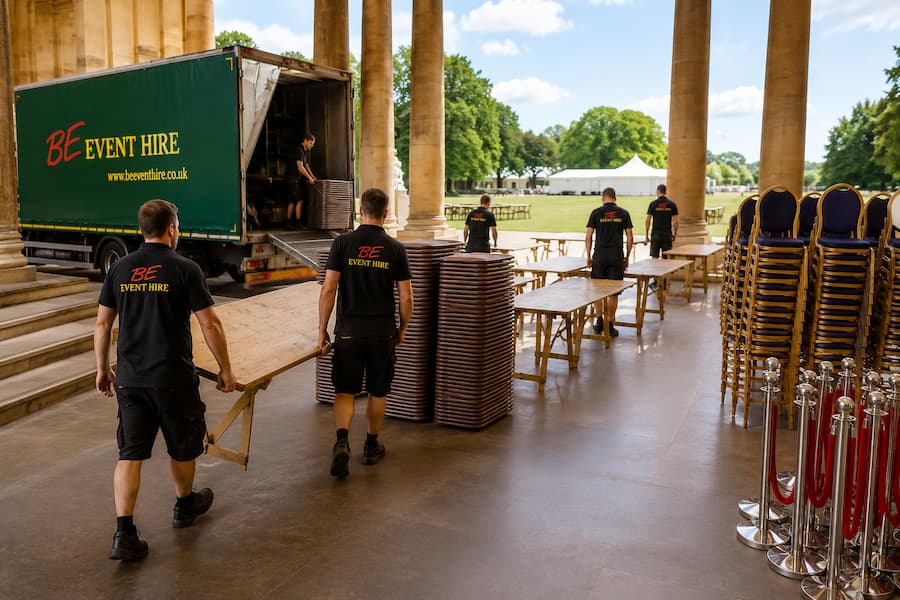
Furniture Within The Build Schedule
Furniture may be one of the most visible parts of the completed event, but it is rarely the first element installed.
Production teams may need to complete flooring, staging, rigging, lighting, power distribution and temporary structures before seating and tables can be positioned. Caterers may also need access to kitchens, service corridors and dining areas before those spaces are furnished.
The furniture delivery should therefore sit within the wider production schedule rather than being arranged as a separate task.
A practical build sequence may look like this:
| Build Stage | Typical Activity | Furniture Implications |
|---|---|---|
| Venue Access | Loading bays, vehicle routes and working areas are opened | Delivery vehicles need confirmed access times and unloading positions |
| Structural Build | Marquees, staging, flooring and temporary rooms are installed | Furniture should remain clear until heavy work is complete |
| Technical Installation | Lighting, sound, screens and power are fitted | Chair rows and tables must not obstruct cable routes or equipment access |
| Furniture Installation | Tables, chairs, barriers and lounge areas are positioned | Items should be separated and distributed by event zone |
| Final Dressing | Linen, branding, flowers and table settings are added | Furniture layouts should be approved before decorative work begins |
This order will vary between venues, but it illustrates the importance of bringing furniture into the site at the right stage.
Delivery Access
Access is one of the most important parts of an event furniture delivery. A short distance on a floor plan can become a lengthy handling route if vehicles cannot park close to the venue entrance.
Before confirming delivery arrangements, establish:
- The correct delivery postcode and entrance
- Loading bay opening times
- Vehicle height, length or weight restrictions
- Parking permits or security requirements
- Lift dimensions and weight limits
- Stair access
- Distance between unloading and installation areas
- Restrictions on trolleys or wheeled equipment
- Time limits for unloading
Delivery and collection charges are calculated using the destination, weight and volume of the order, so accurate location details help the hire team prepare a suitable quotation and transport plan. BE Event Hire provides nationwide delivery from its Leicestershire base, with transport costs included as a separate part of the quote.
City centre venues, hotels, universities, exhibition halls and heritage buildings may each have their own access rules. Sending these details before the event reduces the chance of vehicles arriving at the wrong entrance or crews finding an unexpected handling route.
Loading Bay Coordination
Loading bays often have to accommodate several suppliers within a limited period. Furniture vehicles may be arriving alongside AV equipment, catering stock, exhibition stands, décor, production materials and venue deliveries.
Allocated slots prevent one delayed vehicle from blocking the entire build.
The event schedule should identify:
| Information | Purpose |
|---|---|
| Arrival Slot | Confirms the approved time for the vehicle to reach the loading area |
| Unloading Period | Provides enough time for the order volume and handling distance |
| Vehicle Contact | Allows the venue or production manager to deal with access changes |
| Holding Area | Provides an alternative location if the bay is temporarily occupied |
| Exit Route | Prevents departing vehicles from conflicting with incoming deliveries |
Furniture orders involving thousands of chairs or hundreds of tables cannot be treated in the same way as a small parcel delivery. Sufficient unloading time, clear routes and available handling space are essential.
Furniture Staging Areas
Furniture does not always move directly from the vehicle into its final position. A staging area provides somewhere to sort, count and temporarily hold items before they are distributed.
This is particularly useful for events with several rooms, halls, structures or outdoor zones.
A staging area should be:
- Close enough to the delivery entrance to reduce handling time
- Clear of emergency routes and contractor work areas
- Protected from rain and unsuitable ground conditions
- Accessible to trolleys and installation teams
- Divided by furniture type or event zone
Without a planned holding area, stacks of chairs and folded tables can quickly occupy corridors, fire exits or spaces needed by other crews.
For larger builds, labelling furniture by zone can make distribution much faster. Conference seating, dining furniture, backstage equipment and registration tables can each be grouped before installation begins.
Furniture By Event Zone
Delivering furniture in a logical order can reduce repeated movement around the venue.
The items required furthest from the loading point may be unloaded first so they can be moved through clear routes before nearby areas become busy. Alternatively, some venues may prefer the nearest rooms to be completed first so access can be released quickly.
A zone schedule might include:
| Event Zone | Furniture | Build Priority |
|---|---|---|
| Registration | Trestle tables, chairs and queue barriers | Often completed early so organiser teams can begin preparations |
| Main Conference | Conference chairs, staging and speaker furniture | Installed after technical equipment and cable routes are complete |
| Dining Area | Round tables, trestle tables and banqueting chairs | Completed before linen, tableware and centrepieces are added |
| Networking Area | Poseur tables, stools and casual seating | Can be installed once main contractor traffic has reduced |
| Green Room | Sofas, tables, coat rails, mirrors and refreshment equipment | Should be ready before speakers, artists or production staff arrive |
| Outdoor Area | Picnic tables, benches and barriers | Dependent on ground conditions and temporary structure progress |
BE Event Hire supplies a broad range of tables for events, allowing organisers to source registration, dining, production and hospitality furniture within one order.
Furniture That Installs Quickly
Some furniture types are especially well suited to short build windows.
Folding chairs can be moved in stacks and arranged efficiently in theatres, briefing rooms and ceremony areas. Folding trestle tables are easy to store during transport and can be deployed across registration, catering, production and dining spaces.
This makes them useful for venues that only become available a few hours before guests arrive.
BE Event Hire stocks substantial quantities of core furniture, including thousands of tables and chairs, making it possible to maintain consistency across extensive seating plans and several event areas.
Suitable choices include:
- Trestle tables for dining, registration, catering and production use
- Stackable and folding seating for conference, ceremony and audience layouts
- Poseur tables for networking and standing hospitality areas
- Picnic benches for outdoor dining and crew welfare spaces
- Post and rope systems for entrances, queues and restricted areas
Furniture should still suit the finished event, but handling, stacking and installation time can help decide between otherwise similar options.
Working Around Contractors
Furniture teams rarely have sole access to an event site. They may be working beside florists, electricians, production crews, caterers, stand builders, cleaners and venue staff.
Clear responsibility prevents confusion.
The production schedule should state:
- Which areas are ready to receive furniture
- Which contractor controls each room
- Which routes must remain open
- Where packaging and transport equipment can be placed
- Which layouts require venue or organiser approval
- Which changes can be authorised on site
Installing furniture before overhead work is complete can expose items to dust or accidental damage. Positioning tables before floor cabling has been tested can also create unnecessary work if everything has to be moved again.
A room readiness check before installation can save considerable time.
Setup Assistance
Some organisers need furniture delivered to an agreed access point, while others require assistance placing items throughout the venue.
Setup requirements should be discussed during the quotation stage. This allows the hire company to account for the order size, venue layout, available time and staffing needed.
Important details include:
- The number of rooms or event zones
- Expected furniture layouts
- Distances from the unloading area
- Stairs, lifts or restricted corridors
- The availability of venue staff
- The time by which installation must be complete
BE Event Hire regularly supports substantial installations and can discuss practical setup arrangements as part of the hire process. Giving the team a floor plan or furniture schedule in advance makes it easier to prepare for the work involved.
Floor Plans and Furniture Schedules
A floor plan does not need to be architecturally complex to be useful. It should show the location and quantity of furniture needed in each area.
A straightforward furniture schedule may contain:
| Zone | Item | Quantity | Layout Notes |
|---|---|---|---|
| Main Hall | Conference Chairs | 800 | Theatre rows with central and side aisles |
| Dining Hall | Round Tables | 75 | Ten places per table |
| Registration | 6ft Trestle Tables | 8 | Two separate check in banks |
| Networking | Poseur Tables | 30 | Distributed around the perimeter |
| Backstage | Clothes Rails | 12 | Split between four dressing rooms |
Room names used on the plan should match the signs used at the venue. Referring to the same space as the ballroom, main hall and conference room across different documents can lead to furniture being sent to the wrong place.
Order Quantities
Furniture quantities often change while ticket sales, registrations and guest lists are being finalised.
BE Event Hire allows quantities to be adjusted before the vehicle is loaded, subject to availability. This flexibility can be useful, but late additions may affect vehicle capacity, loading plans and delivery costs.
The most efficient approach is to reserve realistic quantities early and confirm final figures once attendance becomes clearer.
Small contingency quantities may also help with:
- Additional guests
- Damaged venue furniture
- Unexpected staff requirements
- Speaker or performer changes
- Additional registration positions
- Revised room layouts
The exact contingency should reflect the event size and the likelihood of changes rather than simply adding an arbitrary percentage to every item.
Weather Protection
Outdoor and temporary venue builds require additional planning. Furniture arriving before a marquee is complete may be exposed to rain, mud or wind.
Even furniture intended for outdoor use should have a suitable holding area while the venue is being prepared.
The build plan should confirm:
- Whether covered storage is available
- Whether hard standing reaches the unloading point
- Whether vehicles can access the site after heavy rain
- Whether furniture will remain outdoors overnight
- Which team is responsible for moving items into shelter
Hired items should be kept secure and reasonably protected throughout the hire period. Damage beyond repair or missing items may be charged at replacement value, although ordinary signs of event use are treated differently from excessive damage or neglect.
Overnight Builds
Exhibitions, conferences, festivals and broadcast productions may require evening, overnight or early morning delivery.
These timings can provide uninterrupted access, but they need greater coordination.
Check that:
- The venue will be staffed throughout the delivery period
- Loading bays and lifts will remain operational
- Security has the supplier and vehicle details
- Suitable lighting is available along handling routes
- Noise restrictions have been reviewed
- The correct person has authority to approve the installation
Weekend and out-of-hours arrangements should be agreed in advance so the order can be prepared and loaded around the required schedule.
Preparing For Breakdown
Breakdown planning should begin before the event opens.
Once guests leave, several contractors may try to remove equipment at the same time. The result can be congested corridors, blocked loading areas and furniture mixed between rooms.
A breakdown schedule should identify:
| Stage | Action |
|---|---|
| Guest Departure | Keep public routes separate from contractor access wherever possible |
| Event Clearance | Remove personal items, table settings, waste and branding from furniture |
| Furniture Count | Return hired items to their agreed collection areas |
| Furniture Stacking | Fold tables and stack chairs safely where appropriate |
| Collection | Provide clear vehicle access and an authorised site contact |
| Final Check | Inspect rooms and holding areas for remaining hired items |
This sequence can be adapted, but furniture should not be buried behind flight cases, catering waste or dismantled exhibition materials.
Collection Areas
Agreeing a collection point helps both the event team and the hire company.
The selected space should be:
- Accessible from the loading area
- Secure until the vehicle arrives
- Large enough for the complete order
- Protected from unsuitable weather
- Clear of venue waste and equipment belonging to other suppliers
Furniture should be returned to the agreed location unless another arrangement has been made. Leaving chairs scattered across several rooms can extend collection time and delay the venue handover.
For multi-zone events, appointing a member of the breakdown team to check each area can prevent overlooked items.
Removing Linen And Event Materials
Furniture should be cleared before collection.
Table linen, centrepieces, signs, cable ties, adhesive labels, catering equipment and guest belongings can all delay the breakdown if they remain attached to hired items.
Teams should avoid using fixings that could mark or damage furniture. Any branding method should be removable without leaving residue, scratches or punctures.
Catering teams should also remove food waste and liquids from tables before they are folded or stacked.
Safe Stacking And Handling
Furniture must be stacked correctly. Unstable chair stacks and badly folded tables can create hazards during breakdown.
The hire team can advise on suitable handling for specific products. As a general approach:
- Keep chair types separate
- Do not exceed safe stack heights
- Secure folded table legs
- Keep seat pads and loose accessories together
- Do not drag furniture across finished flooring
- Keep handling routes adequately lit
- Leave fire exits and emergency access clear
Furniture should not be placed outside to clear the venue unless suitable protection and security have been arranged.
Missing And Damaged Items
A final count is easier if the order has remained grouped during breakdown.
Missing items are sometimes found in speaker rooms, production cabins, offices or hospitality suites after the main event space has been cleared. Smaller accessories are particularly easy to overlook.
Before collection:
- Check every room included in the event
- Inspect backstage and staff areas
- Look beneath stages and behind temporary partitions
- Confirm loose accessories are present
- Report damaged items rather than hiding them within stacks
BE Event Hire does not usually charge for ordinary marks or minor spills associated with normal event use. Furniture that is lost, damaged beyond repair or returned in an exceptionally poor condition may result in additional charges.
Self Collection
Smaller orders may be collected directly from the BE Event Hire depot in Melton Mowbray.
Self collection is available by prior booking during the stated weekday collection hours. Booking ahead gives the warehouse team time to prepare the furniture before arrival, and there is no administration fee for this option.
Anyone collecting furniture should arrive with:
- A vehicle with enough usable capacity
- Suitable straps and load restraints
- Protection for finished furniture
- Enough people to handle the items safely
- Order details and collection confirmation
Some specialist products require professional delivery or installation and may not be available for self-collection.
Hire Periods And Collection Timing
Standard BE Event Hire rates cover up to one week. The rate remains the same for a shorter period because preparation, checking, loading and unloading are still required regardless of whether the furniture is used for one day or several days.
This can give organisers useful flexibility around a venue build. Delivery may be arranged before the event and collection after the immediate breakdown period, where the venue schedule and booking permit.
Longer hire periods can also be quoted separately.
Payment is currently required in full 72 hours before delivery. Organisers expecting further quantity changes should take this deadline into account when finalising the order.
Build And Breakdown Checklist
| Planning Area | Confirm Before The Event |
|---|---|
| Order | Products, quantities, hire dates and final amendment deadline |
| Delivery | Postcode, entrance, access slot, parking and site contact |
| Handling | Stairs, lifts, distances, trolleys and available staff |
| Installation | Room plans, zone labels, build order and setup responsibility |
| Protection | Covered storage, flooring protection and weather arrangements |
| Breakdown | Contractor sequence, furniture clearing and collection location |
| Handover | Final count, damage reporting and venue sign off |
Event Furniture Hire From BE Event Hire
BE Event Hire supplies furniture for festivals, exhibitions, conferences, weddings, film productions, public events and private functions throughout the UK.
Our extensive stock includes more than 10,000 tables and 30,000 chairs, along with crowd control equipment, production furniture, catering items and accessories. This gives organisers the option to coordinate furniture across guest areas, staff zones, catering spaces and backstage facilities through one supplier.
Our event furniture hire process covers the steps from quotation and order confirmation through to delivery and collection. There is no minimum order, and no deposit is required, making the service suitable for anything from a handful of additional chairs to a substantial event installation.
For practical information on delivery charges, payments, quantity changes, self-collection and hire periods, visit our frequently asked questions or contact the team to discuss your build schedule.
Early coordination gives furniture teams enough time to prepare the order, plan vehicle loads and work around the wider event production. That preparation helps the venue move from an active build site to a finished guest space, then return efficiently to an empty venue once the event is over.
Related Articles
- Furniture Hire That Speeds Up Event Setup
- Furniture Hire Choices For a Festival Crew Area
- Rustic Furniture Or Traditional Hire For Hybrid Events
- Plan Event Furniture Layouts For Large Events
- Choosing Between Trestle Tables and Round Tables For Your Event
Prefer an AI Summary?